


Information from: https://www.goodreads.com/book/show/199798160-my-mother-cursed-my-name
25 June 2025 Book Review by Nayoung Bishoff on Southern Review of Books
Anamely Salgado Reyes’ debut magical realism novel, My Mother Cursed My Name, invites readers on a healing journey through the poignant yet heartwarming story of a Mexican American family.The book’s cover features three dandelions—one wilting, one in full bloom, and one yet to bloom — symbolizing three generations of Olivares women: grandmother Olvido, mother Angustias, and daughter Felicitas. Reminiscent of the magic in Disney’s Encanto, the three women possess supernatural abilities — but with a twist. Rather than celebrating their powers together, they conceal them from one another. As the protagonists begin to share the muted parts of their lives, readers witness their reconnection and recovery through love.
Set in the twenty-first century in Grace, a small Texas town near the U.S.-Mexico border, the story follows Olvido, Angustias, and Felicitas as they reunite for Olvido’s funeral. This gathering marks their first time together since Angustias left home after becoming pregnant at sixteen. The boundaries between life and death, past and present, and even human and nature start to blur: Olvido’s death marks the beginning of her bond with her granddaughter Felicitas, who possesses the supernatural ability to see ghosts. Olvido asks Felicitas to help improve her daughter Angustias’ circumstances — “regarding family, job, husband, and God” — so that she can finally rest in peace. In return, Felicitas asks her to teach her the magical cooking skills that compel people to reveal their secrets.
The entire novel is written in the present tense, with each chapter unfolding the story from the perspective of the character named in its title. This blending of past and present lends an immediacy to the novel that the book’s narrative style complements, and creates a sense of how three women from different generations coexist, each contributing to the fullness of the present. Each character’s name also fulfills its meaning once they all gather together in Grace. Olvido, whose name means “forgetting” or “oblivion,” does not forget her daughter enough to pass on as a ghost. Angustias, whose name means “anguish,” is ironically portrayed as lighthearted and spontaneous. Felicitas, whose name means “happiness,” always frowns and lives with anxiety, especially in response to her mother’s impulsive decisions. However, the meanings of their names truly come alive when they unite and begin to share their suppressed feelings and long-silenced stories. Olvido’s ghost finally finds peace after her conversations with both Felicitas and Angustias in the car on a stormy day, leaving them behind. Angustias becomes more reflective about her mother and daughter — so much so that Olvido observes she is “imitating” her. Felicitas, in turn, finds happiness in Grace, saying, “I don’t want to move because I’m happy here,” as she finds friends who look, speak, and eat like she does. True magic, the story implies, can be found in heartfelt communication and efforts to understand each other.
In the novel, food, passed down and shared between generations, transcends mere flavor and imbues memory, identity, and therapeutic effects, a magical extension of our own world where food carries culture and context with it. What begins as a cooking lesson evolves into Felicitas’ journey to understand her grandmother’s first-generation immigrant life. While tasting food made under her grandmother’s guidance, Felicitas asks Olvido long-buried questions: “What was Mexico like? Why did you leave? What do you miss most about it?” Through these interactions, the thorns in Felicitas’ heart — wounds caused by the generational trauma — begin to burn: “Make sure all the thorns burn.”
If there is any drawback to the book’s emphasis on magic, it is that, at times, it overshadows the characters themselves. Among the characters’ dynamics, Angustias’ verbal communication with Olvido feels less developed, with Felicitas serving more as a mediator between the two. Felicitas hides her magical skill from her mother for much of the novel, and Angustias’ conversations with Olvido do not begin until just a few chapters before the end. However, Angustias’ hardship as a second-generation immigrant is vividly portrayed, and this serves as a bridge to her mother. The novel shows how capitalism threatens immigrant families: “Felicitas is definitely not too much to handle but life is. Rent breathes down her neck as she pushes her shopping cart down grocery store aisles.” Olvido, observing her daughter’s relentless efforts, recognizes the burden she carries and tries to support her with the help of the townspeople.
I found that Reyes’ book shares much in common with other non-fiction works by female writers of color. The novel echoes real-world stories of multigenerational immigrant mother-daughter relationships, illuminating themes of cultural roots, remembrance, and resilience. Michelle Zauner’s memoir Crying in H Mart (2021), for example, tells how the author cooks Korean food as a way to explore her Korean American identity while coping with the loss of her mother. Felicitas’ conversations with her grandmother’s ghost can also be linked to Maxine Hong Kingston’s The Woman Warrior: Memoirs of a Girlhood Among Ghosts (1976), where ghosts can symbolize the haunting presence of second- and third-generation immigrants’ cultural identities. Cleverly combining food and ghosts in the same scene — what is visible and invisible — My Mother Cursed My Name explores how immigrant culture, trauma, and longing impact younger generations both physically and spiritually.
The book wields magical realism not just through the characters’ extraordinary abilities, but also in wordless, symbolic moments—such as when Angustias’ body transforms into the surrounding plants at Olvido’s funeral near the beginning. The novel describes her metamorphosis as follows: “Wrapped up in her sorrow, Angustias doesn’t notice her body becoming one with the plants behind her. The leaves and stems twirl around the strands of her hair. Petals frame her face like long, delicate earrings with a necklace to match.” By blurring the boundaries between the human body and nature, Reyes poetically expresses Angustias’ surrender to fate and the cyclical nature of life and death. Challenging the divisions between the living and the dead, the old and the new, and human life and nature, My Mother Cursed My Name offers a profound exploration of forgiveness and reconciliation within the intergenerational wounds of an immigrant family.

FICTION
My Mother Cursed My Name
By Anamely Salgado Reyes
Atria Books
Published June 10, 2025
https://southernreviewofbooks.com/2025/06/25/my-mother-cursed-my-name-anamely-salgado-reyes-review/

AUDIO Review
S. & S. Audio. Jul. 2024. 11:50 hrs. ISBN 9781797182094. $26.99. F
Reyes debuts with a lyrical multigenerational story about Mexican American women, each of whom carries a name that is both a curse and a secret magical power. Olvido flees Mexico to escape her mother’s debts. Years later, her daughter Angustias becomes pregnant at 16 and runs away from her controlling mother. A decade after that, Angustias’s 10-year-old daughter Felicitas, named for happiness but who always frowns, hopes to one day break from this pattern of desperate flight and find a stable home. Felicitas can see ghosts, and when Olvido passes away, she asks Felicitas to help her grandmother’s spirit move on. This layered and moving family novel balances humor and magic with its more serious themes. There are alternating chapters from each character’s perspective, narrated by Yareli Arizmendi as Olvido, Karla Serrato as Angustias, and Marisa Blake as Felicitas. Collectively, the narrators craft distinct character portraits, capturing each woman’s vivid personality. The audio is further enhanced by the seamless incorporation of Spanish words and phrases, as well as the haunting intro and outro music.
Reviewed by Taylor Skorski , Jan 01, 2025
This review appeared in libraryjournal.com
Mexican American debut novelist Anamely Salgado Reyes's My Mother Cursed My Name heart-meltingly spotlights the complicated relationships between mothers and daughters. "For generations, the women in the Olivares family attempted to change the course of destiny through the power of names." Justa Olivares was the first to attempt a controlling moniker when, in 1917, she named her daughter Calamidades in twisted retribution for her own unjust life. Calamidades escaped calamities, although failure plagued her daughter, Victoria, who then begat Olvido--meaning forgetfulness--who futilely hopes to erase worries and debts.
Memorable Olvido becomes one of three main voices here--a particular challenge, because she's dead. She's survived by her daughter, Angustias, who defied her uneasy name and "grew up to be a joyful and carefree girl." Angustias's pregnancy at 16, however, not only estranged mother and daughter for 10 years, but also grandmother and granddaughter Felicitas (her "sour face" belying her happy name). With so much unfinished family business, Olvido can't reach the afterlife. But Felicitas can see and talk to the dead, which means Felicitas is likely Olvido's only path to salvation.
Reyes is a delightfully easy writer to read, her effortless prose biculturally enhanced with occasional Spanish--and references to toothsome Mexican cuisine. Without minimizing dysfunctional familial challenges--judgment, abandonment, and particularly, poetically, "longing"--Reyes creates a charming narrative about second chances to fix what what's been broken too long. Magical realism provides the redemptive opportunities, but believing is required by both characters and readers to make the magic real. --Terry Hong
Discover: Anamely Salgado Reyes's charming debut novel explores the complicated multigenerational relationships between Mexican American mothers and daughters.
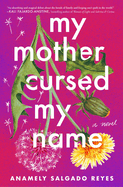
Source: Shelf Awareness : enlightenment for readers online edition of THE BEST BOOKS THIS WEEK
Week of Friday, August 16, 2024 "Anamely Salgado Reyes's "charming" debut, My Mother Cursed My Name", coduments one fammily's "second chances to fix what what's been broken too long" - Dave Wheeler, senior editor, Shelf Awareness